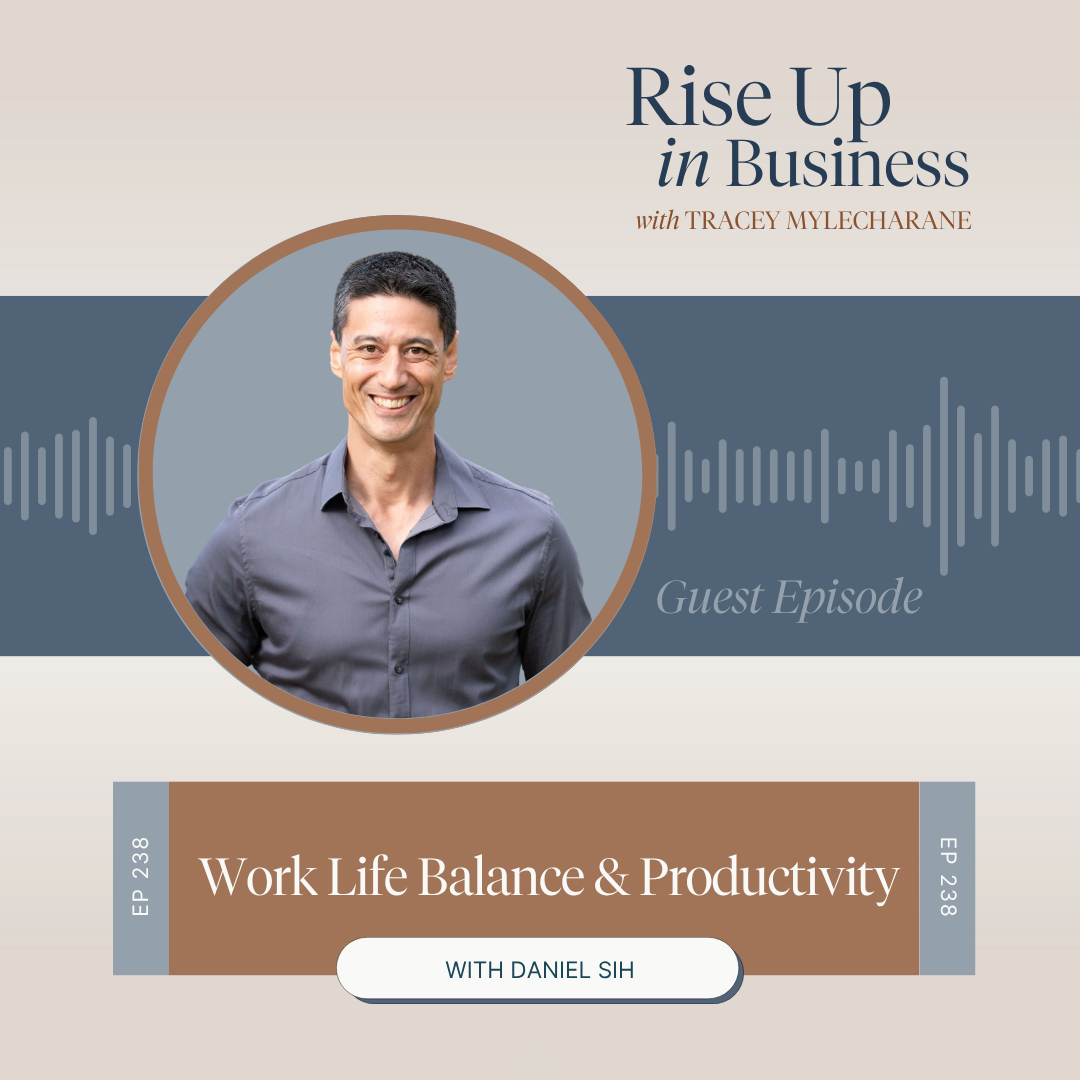
#238 Work Life Balance & Productivity, with Daniel Sih
Send a text message to the show
If you run a business, it can feel like you are never fully off. Your inbox is always there, clients are always there and the next request is always waiting. Even when nothing is truly urgent, it can start to feel urgent because you are living in a constant state of response.
That is where the idea of making space matters. It is a practical way to run a business without it taking over your life.
What making space actually means
Today I’m joined by Daniel Sih, founder of Spacemakers, who describes his work as helping busy people make space and keep pace.
Daniel is an award-winning author, productivity expert, TEDx speaker, podcast host, and founder of Spacemakers®, helping busy leaders reclaim focus, reduce overload, and make space for what truly matters.
Daniel’s award-winning books include Spacemaker, Raising Tech-Healthy Humans, and Wise AI, exploring productivity, digital wellbeing, parenting and the wise use of artificial intelligence in a rapidly changing world.
To Daniel, space is living intentionally and thoughtfully, reflecting on your habits, practices, and systems and shaping your life so you have margin.
Pace is the other side of it. It is learning to work efficiently and effectively, so you can protect time for deep work, family, health and thinking. The goal is to build a rhythm you can sustain.
Boundaries start with a reality check
One of the simplest reminders in the conversation is this. Most of us are not brain surgeons.
That is not just a funny line. It is a boundary tool. It helps you challenge the belief that you must be available at all times or something terrible will happen. Yes, sometimes there are consequences to being offline, but the fear is often bigger than the reality.
When you can step back and ask, “What is the actual consequence if I reply tomorrow?”, you start to create space without needing a dramatic overhaul.
Go upstream: the beliefs that keep you stuck to the inbox
Daniel shares a fable about two fishermen rescuing children from a river. One keeps pulling kids out downstream, while the other swims upstream to find out who is throwing them in.
That is the productivity trap in a nutshell. Many business owners try to solve busyness with more effort, more late nights and more reactivity. But the real cause is often upstream in your internal beliefs.
Common beliefs that keep people “on” include:
“I would feel guilty if I was not available.”
“What if I miss an opportunity?”
“If I do not do it, no one else can.”
“I am valuable because I work hard.”
Until you name the belief, it’s hard to change the behaviour. The goal is to reframe those beliefs so boundaries stop feeling risky and start feeling like good leadership.
How Daniel builds space without losing momentum
Daniel is clear that he loves work and has had to learn how to rest. He describes nearly burning out in his 30s, and realising that rest does not happen automatically. It is something you practise.
Some of the habits he shares include turning off his phone at a set time, not charging his phone in the bedroom, and building daily and weekly patterns that create breathing room.
A standout practice is a weekly digital Sabbath, a full 24 hour period without phones, email, or screens. He also plans holidays before he plans work, and treats those blocks as non negotiable.
Values and priorities show up in your calendar
A big part of making space is being clear on what comes first. Daniel describes a hierarchy of values that includes health, family, inner life, and the ability to think deeply and learn.
That does not mean those priorities take up most of the calendar every week. Business is still demanding. But it does mean that when decisions are made, those values are the anchor.
He also talks about flexibility. Some seasons are intense, like a week of travel and multiple keynotes. The point is not to have a perfect balance every day. The point is intentional patterns of work and rest, planned in advance.
Email is the runway of productivity
One of the most practical parts of the conversation is email. Daniel calls email the runway of productivity. If you cannot get away from email, it is hard to get up into the higher levels of thinking like projects, goals, values, planning and strategy.
The shift is not ignoring email. It is using it with smart strategies and then disconnecting from it so you can do focused work.
A simple example is checking email at set times rather than leaving it open all day. It sounds obvious, but culturally it is rare, and it changes everything about focus.
Making space supports sustainable performance
Daniel is careful to clarify that making space is not only a wellbeing message. It is also a productivity strategy. Pace and space work together.
If you want to be profitable long term, you need boundaries and you need systems. The goal is to build a business you still like, one that supports your life rather than taking it over.
A simple place to start
If you’re feeling reactive, start with one question. What is the greater yes you are protecting?
When you know what matters most over the next three months, it becomes easier to say no to distractions, turn off notifications and set boundaries without second guessing yourself.
Making space is not a one time fix. It is a practice. But even small shifts can create margin, and margin is where better work and better life tend to happen.
-
[00:00:00]
[00:00:49]
[00:00:49] Tracey: Do you know that feeling when you meet somebody and the work that they do resonates with you so deeply that you just want to get more of it? That's how I feel about the work that my guest today does.
[00:01:02] I'm joined today by Daniel Sih, who is the founder of Spacemakers. Daniel is a client of mine. We've been working together for a number of years, and I love what he does so much that I'm so delighted to bring Daniel onto the podcast to share some of what he does with you. Daniel's a wellbeing and productivity coach.
[00:01:22] He helps busy people make space to build intentional and meaningful lives, and that can go in so many directions. I know that that's probably what you're thinking. Daniel's work has resonated with me on so many levels over the years, and I share some of those examples, in the episode today. And the nuggets of gold that Daniel has shared that I know that so many listeners will be able to take away and action is just the tip of the iceberg, even if that.
[00:01:49] There is something here for everybody, no matter what stage of business you're at or where you're struggling or where your pain points are or what your vision or mission is right now. Let's dive [00:02:00] into the episode with Daniel. I hope you love it as much as I do, and I'll be back with you at the end Daniel, hello. Welcome to the podcast
[00:02:13] Daniel: Hi, it's great to be here, Tracey. Thanks so much for having me
[00:02:16] Tracey: Oh, I'm so grateful for your time, and I'm so pleased that you were able to make space to come onto the podcast to talk about this.
[00:02:23] Daniel: Oh, anytime. You've been tremendously valuable in our business, and so it's great to be able to connect with you in this new way.
[00:02:29] Tracey: Thank you. You and I have been working together for quite a while, and we work together in the sense that you're doing all sorts of creative, amazing things in your business, and I support you with all the legal side of things. But in full transparency, I take a lot of value from the content that you share and the conversations we have, and I'm so happy to be sharing that with listeners today because I know that they will get so much value too.
[00:02:54] Before I dive in and start talking about the habits that I've picked up, can you just give us a quick overview of the work that you do with small business owners in the context of making space and productivity?
[00:03:06] Daniel: Yeah. So look, my heartbeat or passion is to help busy people make space, as you've described. Uh, actually to make space and keep pace. So by space I mean, living intentionally and thoughtfully, reflecting on what their habits are, their practices and their systems, and then shaping their life in a way that allows them to have some margin.
[00:03:25] So yeah, that, that's my heartbeat. But I'm a productivity expert, consultant. But by productivity, I mean I want people to think about the life they want, the work they want, what does success look like in the short and long term, and then how do they shape their habits and systems and practices so they can save time, they can improve focus, and actually live the life that they want. And for me, that's what I call making space.
[00:03:48] Tracey: Just all of that, everybody would be putting their hand up and saying, "Yes, please. I'll take some of all of that, please." And that's what I've done in the time that you and I have been working together and I listen to your podcast, which [00:04:00] is excellent, and we'll, we'll talk about that a little bit later. But the concept of making space really struck me when I first met you many years ago, and I thought, "Gosh, what does that actually mean?" And then your LinkedIn is very good for little nuggets of gold that you share, and you're very good at sharing what it is that you've been doing in your own life to make space. And I had sent you an email once, and I got your out-of-office reply, and I loved it so much that I stopped what I was doing and I sat back and thought, "What does it mean to make space?"
[00:04:30] Because you'd said something along the lines of, " You're away from your inbox. You're doing X, Y, Z. If it's urgent, contact your assistant here. However, I'm not a brain surgeon, so it's probably not that urgent. You could take this an opportunity to make space." And I loved that. That was the reaction I got.
[00:04:47] I thought, "Oh, I wish that I could do that." And I sat back and thought, "I'm actually going to go and do that." And I started making space really intentionally. So that's phrase that's used in my household often, Daniel, about just making space and spaciousness and what that looks like. And I tell you, I feel like I'm a work in progress, but there is some grounding to it. There's some grounding to it. Can you just talk about the concept of making space?
[00:05:12] Daniel: Yeah. Look, I love it. It's the first time ever on a podcast that anyone's quoted my out of office. Um I've had books quoted, but never my out of office reply, so this is a first.
[00:05:22] Tracey: It really resonated.
[00:05:23] Daniel: Oh, it's great, but it's true, right? I mean, look, I used to be a physiotherapist, so I have a health background. Maybe that's where it came from.
[00:05:29] But I'm a productivity expert. No one's gonna die if they don't get a response back. So what you've really touched on, I think, is an aspect of making space. There are a number of parts of that, which is boundaries, which is having a sense of, you know, how important is your work really? How essential is it?
[00:05:48] Or, you know, what are the consequences of you not being available? And how can you actually get a bit of a rain check on your own kind of importance so that you can step back from work, not be [00:06:00] available, not be able to be contacted, and actually have space so that you can live a life and be at your best.
[00:06:05] I think it's very hard for business owners. We feel like we have to be on all the time. We're fearful that if we don't respond, something terrible will happen. And look, maybe some somewhat bad things will happen, but again, we're not brain surgeons, right? Probably. If you are a brain surgeon, well, you know, someone else can cover the brain surgery when you're on holidays.
[00:06:24] But I think part of making space is reflecting on your beliefs, and actually accepting that we need to be human and we need to love our businesses. I've coached a number of leaders who have become quite successful and then they turn around and say they actually hate their business because it doesn't give them a life.
[00:06:38] Their business has taken over their life and they built a business to have a life. And so we need to constantly reflect on what is it that we're doing, why are we doing it, and then how do we actually have patterns of on and off, what I call keeping pace and making space. How do we become more efficient and effective in what we do, and also know how to unplug, disconnect, and actually be human?
[00:06:58] And that's actually the secret of what it looks like to live sustainably and to be profitable longer term. So I know you've just mentioned an out of office reply, but the heartbeat behind that is actually if I need to go away for two, three weeks with my family and not be available, I don't check my email.
[00:07:14] I've created systems and people who can actually review and support my business. And yes, they can call me if there's an emergency, but it happens very rarely.
[00:07:24] Tracey: So you mentioned something that I think let's dive into. You mentioned something I think is really important. At the beginning of that, you'd said the business owners that you've worked with are fearful that if they don't respond, something's gonna happen. Is it fearful that something's gonna happen, or is it fearful that the work will fall away, that there won't be any more clients, that they need to be delivering?
[00:07:46] What's underpinning the fear that keeps us, myself included, stuck to the inbox and, and the constant need that we feel the need to be on and available?
[00:07:58] Daniel: Yeah. Yeah, look, I think there's a [00:08:00] lot of different types of fears. I might share a story if that's all right, and then I'll come back. So there's a great story by Dan and Chip Heath, and I'm sure-- No, it's a fable, but there are two fishermen. They're on a beautiful lake. It's sunny. They're enjoying the day, and then all of a sudden they see a child splashing around in the water.
[00:08:16] This is a fable, so let's not get too freaked out, okay? So this child's drowning and they quickly paddle over and they pull the child out of the water and they, you know, they're kind of helping this poor child recover and wondering how they got in the water. And then they see another child a bit further downstream who are just like, same thing, drowning, splashing around.
[00:08:32] So they're like, "Oh my gosh." They quickly paddle over and grab this child. And then, then as they do that, they realize there's two other children, like at a different part of the river who are all splashing, and they're like, "This is insane." So there they are going back and forth, back and forth, trying to rescue these kids.
[00:08:46] It keeps happening, and as they kind of get to the point where they can't possibly rescue all these kids, one of the fishermen jumps out of the boat, swims to shore, and he just kind of just disappears. As he's doing so, his mate says, "Where are you going? We have to rescue these kids."
[00:09:01] And his mate who's swimming turns around and says, "I'm going upstream to find out who's throwing the children into the river." And, I love this idea that sometimes, sometimes-- Okay, so obviously with systems, processes, we're reactive, we're frantic. That's the obvious ex- I don't know, moral of this story, that sometimes we have to go upstream to work out why we're so busy and frantic.
[00:09:20] But what I've recognized coaching hundreds of leaders is I actually think we have to go upstream in terms of our internal beliefs, monologues, and ideas. What Nir Eyal, who wrote Beyond Belief," would call a, a limiting belief. We actually need to reflect on our limiting beliefs because I'm convinced that they are upstream to our inability to slow down, set boundaries, and make space a lot of the time. So if I go to your question, what is causing the fear? Meaning what stops us from being able to actually have a life, to live sustainably, to have boundaries where we need to and to disconnect from the noise when it's helpful. I actually think a lot of the time it's a series of limiting beliefs that we have that we're not willing to confront, [00:10:00] and we almost need to identify them upstream in order to reframe them from a limiting belief to a liberating belief so that we can actually shift our boundaries and have an out of office on and actually not check our email.
[00:10:13] So when you ask the question, what's behind the fear? Well, I've coached lots of people, and there's clearly multiple factors that lead to fear, but common things I hear are, I would feel guilty if I wasn't available." "What if I miss out on this opportunity?" "If I can't do this, no one else will be able to do it."
[00:10:30] You know, "I'm the only one who can do this." Sometimes it's actually, "Oh, I just love new things, and I, I love opportunities, so I don't wanna stop." Sometimes it's, you know, "I'm the busiest person in the room," or, " I'm valuable because I work hard." Or business owners have to work hard. That's the only way they survive, right? So again, unless we go upstream and work out what are the particular beliefs that stop us from unplugging, putting on an out of office, and finding strategies to use VAs or team members or, you know, depending on the size of your business, to actually have some time off, then I think it's gonna be very hard to actually put in what I call the space maker practices.
[00:11:05] So it's both/and. Beliefs and then rituals, practices, and habits to actually live a good life and to be productive. I mean, I, I have a highly successful business. I'm pro-business, I'm pro making money, I'm pro working hard, and I'm pro making space so that we can live a life and enjoy the business we've created.
[00:11:23] Tracey: There's a lot there. Thank you for sharing go back to that. How do you do it? So I'm not even going to dive into all the things and, and I'm not even going to use myself as an example because as I said, I'm a, I'm a work in progress, but very happily working in progress and certainly making good progress.
[00:11:40] How do you do it? Talk to us about that. So you do have a successful business, you do make money, you do have space, you do, it looks like from the outside, have balance because you've just come back from a fabulous time away with your family. How do you do it?
[00:11:55] Daniel: Yeah. Look, I love the quote, " I teach best what I most need to [00:12:00] learn." And, like, I nearly burnt out in my 30s, so, you know, I come from a place where I worked my guts out. I'm a type A personality. I love creating stuff. I'm entrepreneurial by heart. And I got to the stage where I nearly burnt out, you know, to the point where I had breathlessness and some other issues.
[00:12:15] So I, I suppose I came from that place, and that's why I care so much about helping people be highly productive and deeply human, which is what my book "Space Maker" is about. And so that doesn't leave you. You know, I mean, I, I'm someone who has to wrestle constantly with not starting. Like, if you give me a long holiday, I'll come back and start a new business, you know? Like, I need to be careful.
[00:12:38] Tracey: Okay.
[00:12:38] Daniel: Not to start the new thing, you know? Like, So that's kind of my personality type, if that makes sense. And I love working. Like, I love what I do. I actually find it harder to rest than work. So, within that context, what I've discovered is, I need to practice rest.
[00:12:58] I need to work out what is work for me, what is rest for me, and how do I habitualize rest, and then how do I build it into my pattern as a routine, not just because it makes me more productive, but because actually I want a breadth and depth in my life that isn't just work. But I have to discipline that part.
[00:13:15] So some people have to discipline themselves to work. I have to discipline myself to rest. So look, there's lots of practices. I mean, I turn off my phone at a particular time of the night. I don't charge my phone in my bedroom, so I start and end the day with a bit of space. I have a weekly-- this is the big one, I have a weekly digital Sabbath, so I have no phones, email, and screens one 24-hour period every week, and I habitualize that.
[00:13:39] Now, there's a lot of, like, beliefs and practices that are built into that, but that's where I'm at now after practicing that for a while. I have regular holidays, and I plan my holidays before I plan my work. So I'm a professional speaker. At the beginning of the year, I put in my holidays and that becomes sacrosanct.
[00:13:56] So if anyone wants me to speak, even if it's, you know... I had a, I had a [00:14:00] huge client, I won't say the name because everyone knows the company, but I would've loved to work with them, but they asked me to do a conference during my holidays. Now I book my holidays and you don't get in my calendar. So I just gave up that opportunity.
[00:14:13] Maybe I'll never get to work with this global client, but I walked on the Camino with my kids and I had a great holiday. So, it comes down to intentionally creating daily, weekly, and annual habits of making space, and then working very, very efficiently and well around the sides.
[00:14:31] At least that's kind of one of the strategies. But again, it means going upstream first so that I value space, and so I truly believe that I'll have a more successful business if I work smart and rest well.
[00:14:45] Tracey: Two things so much, so much I'm busting to ask you after that. Two things. You've said you value space, so in the work that you've done upstream, is part of that work getting really clear on priorities? Because it sounds to me like your holidays and your space are a really high priority, and perhaps that's where some of us fall down because we don't have that clarity on the priorities.
[00:15:09] Because there'd be so many business owners listening to this thinking, "Holy dooley, if that was my business, I would have, whether it be right or not, taken time away from my holiday to go and work for that client." But I'm finding it so empowering that you didn't, and I'm thinking, gosh, that's walking the walk after talking the talk right there.
[00:15:29] But there was work to do before you got to that point, because that wouldn't have been easy. So at some point time that wouldn't have been easy. It sounds like it was easy when you did it, but at some point...
[00:15:39] Daniel: Oh, no, it wasn't easy. I still wonder whether I could have taken that client, you know? But that's a value that you put in place, right? I suppose it's a hierarchy of values, what comes first. Well, my health, my family, my inner life, the ability to think deeply and be strategic, the ability to learn.
[00:15:56] Like, these things come above the frantic activity. Now, of [00:16:00] course, there have to be compromises. This may date your podcast episode, but it's the census week this week, and I had the most frantic busy week of, I reckon, my entire work career last week.
[00:16:11] I spoke four keynotes in four cities of Australia, plus I ran other online courses. I did 25 hours of actual delivery in some major conferences. It was insane. And I added up my hours 'cause the census said I had to, and I did 75 hours, which is like a huge week, right? But then on the weekend, I made sure I had absolutely zero commitments and no plans, 'cause I knew I'd need that.
[00:16:35] Plus, I had a massage 'cause we preloaded that. And next weekend I'm, I'm flying my whole family up to Melbourne 'cause I'm again away for two weeks traveling, which is a lot of activity. So I've preloaded that I'm gonna have a weekend in Melbourne with my family because, A, I've got a bit more money because I'm earning a lot this month, and B, I knew in advance that I wouldn't have enough family time.
[00:16:55] So that's more of a boom and bust type of pattern. Work really hard and then have time with my family, which isn't the ideal, but you have to be flexible. And there are times where you work hard and then you rest hard. There are times where you try to get a more balanced cadence and rhythm. But I think it's about, look, the "Spacemakers," the podcast is all about living an intentional, meaningful life.
[00:17:18] This allows me to earn a heap of money, make a huge impact across Australia, and still build the relational capital I need with the people I care about most. And so that's the way I'm running it this month. It'll change next month. It's less of a disciplined everyday reality and more of an intentional way of living, if that kind of makes sense. Which is what business is. You have to flex, right?
[00:17:37]
[00:17:37] Tracey: It is, absolutely. And I'm loving it so much because again, coming back to priorities, and it seems to me like the priorities and the values are going hand in hand here, and you are really clearly very anchored to your values. So you are really clear on your priorities. You just listed them off the top of your head.
[00:17:51] You listed five, and business being a priority, but it was number five. I love that. And then you're making decisions around the use of your [00:18:00] time anchored into those values and priorities. The work, you'll do it, but you need the family time and you've got to make time for the rest. And I'm loving that it is so flexible.
[00:18:07] As I'm just imagining in my mind Lego pieces, and you're just moving them around to suit what's happening at the time. So there's freedom and flexibility in that. And so when we hear this sort of thing, get clear on your values and your priorities, straight away we start thinking, "Ugh, I'm gonna be locked into this, and it's all about discipline and I don't have willpower."
[00:18:25] But you're not saying any of that. You're saying it's so free and flexible, but it comes after having the clarity on the values because you then know where to put those pieces. Would that be fair representation?
[00:18:38] Daniel: I, I think that's true. Now, maybe two caveats for the practicality of it while I've put it in that order. So firstly, sometimes they get it wrong because, I mean, we run small businesses, right? And like, they're tough, and sometimes the work's not there, so you have to do extra hours. Sometimes the work is there, so you have to do extra hours.
[00:18:58] So I mean, I'm, there's a bit of realism in this. When I say that's my value set, it absolutely is, you know, my health, my inner life, my kids, my family. But that doesn't mean they get the bulk of my time, you know? So that's important to recognize. I still work really hard, but when I make decisions, they come first. But doesn't mean I'm spending all my time with my family. Does that kind of make sense?
[00:19:20] So, you can have them as a priority and yet not representing the bulk of your calendar because life is life. The other thing, I loved what you said. I, I think that prioritization requires a context.
[00:19:32] And so when people say to me, "I'm struggling, you know, with back-to-back meetings, with my inbox, with constant noise, the inability to prioritize." And this is the bulk of what I do. I teach people how to work smarter. I always ask them, "What are your greater yeses? Like, what are you trying to achieve?"
[00:19:48] And if the clearer people are about what matters, what their yeses are, what their values are, what strategies and activities lead to success in the business, well, the easier it is to say no to that email, to turn off those notifications, [00:20:00] to say no to that opportunity, that podcast, that event, because it's gonna be a no for a greater yes.
[00:20:06] So that requires that you do the internal work and the strategic work that you know what drives your business outcomes and you know what your values are in your life. Like, what does it look like to create a business by design so that you can then say no, set boundaries, and actually shape your practical calendar, email, and time in alignment with that.
[00:20:29] So prioritization requires a context, whether it be values or whether it simply be your strategy and tactics. So I think we're speaking the same language, but I kind of wanted to broaden it out to get practical because it is a very practical reality here. You can't unplug from an email if you don't know what your goals are for the next three months as a business. It's so important to step back and actually think deeply about where you're heading.
[00:20:52] Tracey: Which is the clarity piece, and I picked that up on just about everything that you're saying comes back to the clarity piece. We will put into the show notes all of your details, and I wanna talk about the podcast in a moment because I do listen to that.
[00:21:03] Your LinkedIn is so valuable. I do share things with you sometimes. I do comment sometimes. I am a lurker though, on LinkedIn. I self-confessed I am a lurker. I don't do that much commenting and interaction on LinkedIn whether I should or not, I don't know. But you share so much value on there that business owners can actually take away and implement right now.
[00:21:23] And one of the tips that I've picked up from you, which I've probably never shared this with you, is one of your email strategies, your inbox strategy. So I have two set times a day now that I will go into my inbox and I will sit. It takes me a long time. There's a lot to do in there. But I allocate an hour and I will sit and I'll do what I can in an hour, and then I come away, and then I'll go back later in the afternoon and I do the same thing.
[00:21:46] And I don't always get it right, but I'm getting better. But that has been a game changer for my focus because what I was finding is I was falling into a space of I'm constantly in my inbox wanting to make sure I'm [00:22:00] responding to everybody as quickly as I can, which was foolish because nobody expected me to respond instantly.
[00:22:06] But it was eating up all of my day and I wasn't being productive, and then I was finding I was working really late at night and I need my sleep and I wasn't getting it. So the whole thing was just getting untenable. And then I saw something so simple, which was, " Don't do that. Don't do that. Just pick two times."
[00:22:22] And I did. And this is something that up on your LinkedIn. It was something so small which had such a significant impact. And I'm hearing myself as I say this out loud and you think, "Oh gosh, dur. Well, it's not genius, Tracey. Of course you shouldn't be in there all the time." But it's hard because I didn't have clarity on how I wanted to be spending my weeks.
[00:22:41] Daniel: Oh, you're in the vast minority. I mean, Email Ninja is how I started my business 15 years ago. Like, it's an inbox zero course. It helps you get to zero. And I mean, I've asked thousands of leaders, "Okay, when you're at your desk and you've got your screen on, I ask kind of as if I'm dumb, "How often in the day would you have, email open?
[00:22:59] Would it be five times a day or three times a day?" And then like people looking, you know, like, "Uh, duh. Does not compute. I don't understand the question." Like, it's all the time. Of course, it's all the time, and they just multitask all the way through the day. My assumption is you're also, you've also turned off email notifications if, if you're unplugging.
[00:23:19] So you turn off email notifications and basically either you have a rhythm of checking email a few times a day, or simply that you have times where you don't check email to do focused deep work, like you're in the top one, I don't know, the top 5% of people who will be able to achieve meaningful work, and yet it's very hard to do culturally.
[00:23:37] So no, I 100% agree and I say email is the runway of productivity. If you can't get away from email, which doesn't mean you ignore it, it means you have really smart strategies to use it really well when you're using it, to prioritize, to use AI, to make great decisions about when to delay and when to action emails, and then disconnect from email.
[00:23:59] If you can't [00:24:00] do that, well, then you can't get up off the runway into the higher levels of thinking, which is projects, goals, values, planning, strategy. So you do need to actually have basic productivity tools to manage your communication and other kind of inputs so that you can not be drowned by them and directed by them day by day.
[00:24:20]
[00:24:21] Tracey: Productivity tools.
[00:24:22] Daniel: Well productivity helps you make space. So when I say-- So I'll, if that's okay, when I talk about making space, that doesn't mean having long holidays all the time and always turning off your phone. It actually requires that you keep pace. So you know how to use email well, you know how to turn off notifications, you know how to use AI, you know how to manage your cognitive load with to-do lists, you know how to time block, you know how to create rhythms and structures so that you actually get your best work done.
[00:24:50] That's part of making space. Like it's pace and space are the yin and, yin and yang of productivity. If you don't work fast and smart, and if you don't set boundaries and disconnect, you can't be productive. It's both and it's not just a wellbeing message. I, That's really important just to clarify, because we've mainly focused on the wellbeing aspect, if that makes sense.
[00:25:08] Tracey: Yeah, we have, and I'm glad that you shared that, because in my mind that's why we do it. We make sure that we are looking after the wellbeing so that we can be productive and we, and we can do all the things. So thank you for sharing that. You mentioned Email Ninja. I know that that's on your website.
[00:25:23] There's quite a few resources on your website. We're going to include the link to your website in the show notes for anybody who wants to dive into this, because your website is very helpful, as are your books. And you mentioned the "Spacemakers" book, but you also have "Wise AI," which I think is really relevant as well for business owners.
[00:25:41] Daniel: Yeah, "Spacemaker" and "Wise AI" are the two, uh, workplace books. Actually, if you're interested with email stuff, emailninja.com is our website for just Email Ninja as opposed to my main business website. You can get three videos to show you how to start [00:26:00] the email journey.
[00:26:01] They're completely free, uh, and they can be useful. Feel free to have a look.
[00:26:04] Tracey: That's amazing. That's an amazing resource, as is the podcast, the Spacemakers podcast, and that's something that I listen to regularly. You have lots of guests. You have some really good conversations where you can just pick out nuggets of gold that you can actually just take away and implement into your business, which is what I try to do with this podcast and I love that it's a very user-friendly podcast, your podcast, such that you don't need to actually carve out, you know, half a day to listen to things and then try and work out what it all means.
[00:26:30] It's all very clear and, and very practical and very doable. So that's something else that we'll include in the show notes as well. And we'll also include the link to your website. Daniel, thank you so much for your time. We could talk for hours, I think, on all of this, but I love that we've just touched on some of the key things that you do to set yourself up for success in your business and your life and some of the little nuggets that I've taken away and, and that I'm happily working away on in my own business. So thank you.
[00:26:56] Daniel: Thank you so much. It's been great to have a conversation
[00:26:59] Tracey: We could have talked for hours. I know that you sense that too, and what Daniel was able to share and what I was able to share in that short and sharp episode was just a hint of the sort of work that he does with leaders and the impact that the work that he does has on business owners, leaders, organizations, founders.
[00:27:19] So I shared some of the ways that I've implemented Daniel's nuggets of gold over the years, and I hope that there was something there that you resonated with too. I'm sure there would've been. We will include the details to Daniel's podcast, the Spacemakers podcast, and the website in the show notes below.
[00:27:38] And also the Email Ninja website that he mentioned. We'll include that in the show notes too, so you can dive in and take a look and take what works for you for now. If you know a business owner that you think would benefit from listening to the conversation I had with Daniel, please feel free to share the episode.
[00:27:53] It would mean so much. Together, that's how we get the podcast into the ears of even more business owners. As always, thanks so much for joining me. I'll [00:28:00] catch you next time.
[00:28:00]
LINKS:
Connect with Daniel:
Website: https://www.spacemakers.au
LinkedIn: www.linkedin.com/in/danielsih/
Podcast: https://www.spacemakers.au/podcast/seasons
Email mini-course: https://www.spacemakers.au/email-ninja/
Sign up for my fortnightly Atelier Briefings here
Check Your Legals with the Essential Legal Checklist here
Book a Complimentary Introduction Call with me here
Join Me on Social:
Rate, Review and Follow me on Apple Podcasts
If you are loved this episode, please consider rating and reviewing my show! This supports me in helping to empower more coaches, creatives and consultants - just like you - protect what they're building, and move forward with confidence in their business. It's quick and easy - click here, scroll down to the bottom, tap to rate with 5 stars and select 'write a review'. As always, I'd love to know what you think, and what you loved most about this episode. Also, don't forget to follow the podcast to stay up to date with the latest episodes.