Every interior designer in Australia needs a tailored design agreement, website terms and conditions and a privacy policy, plus the right insurance. Your design agreement should cover your scope, fees, variations, intellectual property, cancellation, liability and your role on site, and clients should see it before they pay. If you visit client properties or send a team on site, you also have work health and safety obligations and need public liability insurance.
As an interior designer, you have an incredible eye for beauty and balance. You understand the importance of creating a cohesive, well-thought-out space that reflects your clients' wishes. Your legal documents deserve the same care, because they protect your business, manage client expectations and shape how clients experience working with you.
Here are the legal documents and protections every interior design business needs.
1. A tailored design agreement
The cornerstone of your client relationships is a well-crafted design agreement. Your design agreement should include:
the scope of your services and deliverables;
your fee structure and payment terms;
the project timeline and milestones;
variations, so scope creep is managed and paid for;
intellectual property, including who owns your designs, drawings and concepts, and what clients can do with them;
cancellation and termination clauses that are fair under the unfair contract terms laws;
liability limitations and warranties; and
how disputes will be resolved.
Sequence matters too. Under the Australian Consumer Law, your client needs to see your terms before they commit. Share your proposal or scope of works together with your design agreement, once these are accepted, you can then issue your first invoice.
If your cancellation clause charges a large fee no matter how much work has been done, read Interior designers, are your contracts still protecting you?
2. Be clear about AI
AI tools are changing how designers work, and how clients engage with design. Your design agreement should deal with both sides.
Your designs in your clients' hands. Your concepts, mood boards, drawings, specifications and renders are your intellectual property. If you don't want clients putting them into AI tools (to generate variations, or to have someone else build out your design for less), your design agreement needs to say so. Without a clear restriction, it's much harder to object later.
Your own use of AI. If you use AI in your design process, whether to generate concept imagery or renders, draft specifications or write client communications, tell your clients at the outset. Your design agreement or onboarding should explain:
what you use AI for;
that the creative work and design decisions are yours, not an AI tool's; and
that you won't put their personal information, including photos and floor plans of their home, into AI tools.
Being upfront builds trust. A client who finds out later that AI was involved in their project can feel misled, and in an industry built on relationships and referrals, that's a hard thing to repair. Protecting personal information matters for privacy too: the Office of the Australian Information Commissioner recommends against entering personal information into publicly available AI tools.
3. Cover your on-site work
Every time you step into a client's home to take measurements, supervise a furniture delivery or oversee an installation, that space becomes your workplace too.
Some designers work mostly virtually, with the occasional site visit for measurements. Others are on site regularly, liaising with trades and overseeing installations. Both are perfectly valid, but they need different protections. Your design agreement should clearly set out:
the scope of your on-site services;
your role in managing deliveries and liaising with contractors;
access arrangements and responsibilities;
quality control procedures; and
what your client is responsible for.
The time you spend being crystal clear about these details upfront can prevent significant headaches later.
4. Your team and work health and safety
As a business, you have work health and safety (WHS) duties to the people who work for you and anyone affected by your work, including on a client's site. If you send employees or contractors to site, make sure they know the site risks, have what they need to work safely, and that your workers compensation insurance is in place.
5. Insurance
Insurance is non-negotiable. As a minimum, you need:
Professional indemnity insurance: whether you work remotely or on site, this covers claims arising from your professional advice and designs.
Public liability insurance: essential if you visit client sites. I've seen designers who thought they weren't responsible for an incident drawn into claims anyway.
Workers compensation insurance: a legal requirement if you employ staff. If you're a director of your own company, check whether you're covered, because the rules vary between states and territories.
6. Website terms and conditions
Your website is your digital storefront and portfolio. Protect it with website terms and conditions that cover:
how your portfolio images and content can (and can't) be used;
copyright and ownership of the work you display;
acceptable use of your website; and
disclaimers about the content on your site.
(Some of my clients use lower-resolution portfolio images or watermarks to discourage copying.)
7. A privacy policy
If you collect personal information through your website, enquiry forms or client onboarding (and every designer does), a privacy policy explains what you collect, how you use and store it, who you share it with and how people can contact you. If the Privacy Act applies to your business, your policy must also meet the Australian Privacy Principles. Read more in Does my small business need a privacy policy?
Make your legal documents part of your brand
Most designers think of legal documents purely as risk management, and they are. But they can also reflect your brand's style and professionalism.
Picture this: you've had a wonderful discovery call with a potential client. Your follow-up arrives in their inbox: a beautifully presented proposal, with your design agreement attached, that's clear, on brand and sets expectations from the start. Your client feels confident and excited about working with you because your process is as polished as your designs. From invoicing and project updates through to your final walkthrough, every touchpoint reinforces your brand.
And when things go slightly off track (as they sometimes do), clear contracts let you handle it with grace and professionalism, keeping the trust you've built. In an industry where referrals are gold, that experience is what clients remember.
While templates can be tempting, DIY is for Bunnings, not for your legals. Your documents should reflect the way your business actually works.
You may also like to listen to episode #166 of the Rise Up in Business podcast, Six ways to legally protect your interior design business.
Need help with your interior design contract? Download the free Interior Design Self Audit Checklist to see whether your client service agreement protects your business the way it should, then book an introduction call.
This article provides general information only and does not constitute legal advice. Your obligations depend on your specific circumstances.
Frequently asked questions
What legal documents does an interior designer need?
A tailored design agreement, website terms and conditions and a privacy policy, plus professional indemnity and public liability insurance, and workers compensation insurance if you employ staff.
What should an interior design contract include?
Your scope of services, fees and payment terms, timeline, variations, intellectual property, fair cancellation and termination terms, liability limits, your role on site and how disputes will be resolved.
Do interior designers need public liability insurance?
If you visit client homes or sites, yes. Public liability insurance covers you if someone is injured or property is damaged in connection with your work.
Should my design agreement deal with AI?
Yes. Say whether clients can put your designs into AI tools, and tell clients upfront how you use AI yourself, including that the creative work and design decisions are yours and that you won't put their personal information into AI tools.
Further reading
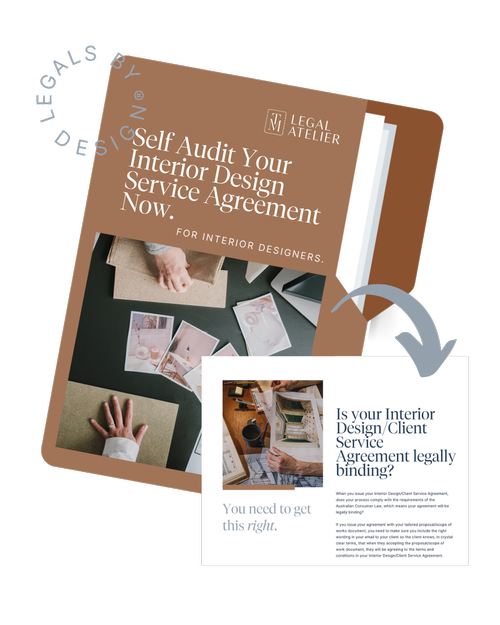
Free download for interior designers
Put your client service agreement to the test with the Interior Design Self Audit Checklist. Know with confidence, once and for all, whether your agreement protects your business the way it should.
Send It My Way