
Since 9 November 2023, it has been unlawful for Australian businesses, including interior designers and stylists, to include unfair terms in their standard form client contracts. The clause that most often causes trouble is cancellation: charging a client a large fee to end a project early, even though much of the design work hasn't been done. An unfair term can't be enforced, and companies face penalties of up to $50 million. Review your client agreement, and make sure clients see your terms before they commit.
There's a lot for interior designers and stylists to consider when developing their client service agreements (aka client contracts), and this applies even more so today than ever before.
It's worth pausing here to note that just because a clause has been included in a contract doesn't mean it can be enforced. (You might want to read that twice.)
Consumers are becoming increasingly aware of their rights around contract terms and cancellation, and that's partly thanks to the national discussion around the unfair contract terms laws that changed in November 2023.
What changed in November 2023
Unfair contract terms laws have protected consumers for years. Until November 2023, though, the only consequence was that an unfair term was void. If you got it wrong, you simply couldn't rely on that clause.
The Treasury Laws Amendment (More Competition, Better Prices) Act 2022 changed that. Since 9 November 2023:
Including an unfair term in a standard form consumer or small business contract is prohibited, and so is relying on one.
Penalties apply. For a company, the maximum for each contravention is the greater of $50 million, three times the benefit obtained, or 30% of turnover during the breach period. For an individual, it's up to $2.5 million.
More contracts are covered. A contract is a "small business contract" if at least one party has fewer than 100 employees or annual turnover under $10 million, and the old contract value limits no longer apply.
Does this apply to interior design contracts? If you use the same agreement or terms for your clients, with little room to negotiate, then yes, it most certainly does.
What are unfair contract terms?
A term is unfair if it:
causes a significant imbalance in the parties' rights and obligations;
isn't reasonably necessary to protect the legitimate interests of the business relying on it; and
would cause detriment (financial or otherwise) to the other party if it were relied on.
Courts also look at how transparent the term is (is it in plain language and easy to find?) and at the contract as a whole. And it doesn't matter what you call your document. Client service terms, design terms, a proposal or a scope of works with terms attached: if it's your agreement with your client, the law applies.
The cancellation clause problem
One of the most common examples I see relates to cancellation and termination clauses. They typically say that a client can't end a project early unless the designer is in breach, or that if the client does cancel, they must pay a hefty fee. That fee often applies regardless of how much of the design work has actually been done (and sometimes none has). The clause doesn't take into account that a large part of the services hasn't been delivered, so the client is paying for value they haven't received. This sort of clause is likely to be an unfair contract term.
To fix this, think carefully about what a reasonable cancellation clause looks like for your business. Consider:
What's reasonably necessary to protect the legitimate interests of your business?
How does your workflow operate? Did you turn other work away to take on this project?
Do you have a waitlist? Could you bring other work forward, and how much lead time would you need?
How much time have you spent on the project so far? Keep itemised records.
If furniture procurement or custom design is part of your services, what orders or commitments have you already made?
A fair clause usually lets the client cancel with reasonable notice, pay for work done and costs you've genuinely incurred, and possibly pay a fair cancellation fee that reflects your real loss.
What happens if your contract includes an unfair term?
If a court finds a term unfair, it's void: you can't rely on it. The court now has the power to set aside the entire contract. On top of that, the court can impose penalties.
It's simply not worth the risk.
Sequencing matters too
Fair terms are only half the job. Just as important is the order in which you send things: your proposal, quote, scope of works, terms and conditions, and agreement. Under the Australian Consumer Law, your client needs to see your terms before they decide to go ahead, with a genuine chance to read and consider them.
I can't stress the importance of sequencing enough. It's by far one of the most common areas where I see interior designers and stylists go wrong, and it's simply due to a lack of knowledge (we don't know what we don't know, after all).
Moving forward
Interior designers and stylists, this means reviewing your client agreements and contracts, and your processes and systems too. Engage your business lawyer to get the advice you need to get this right. Remember, in business, prevention is better than cure.
Review your legal documents, including client agreements, at least once a year, or when something changes in your business. That way you'll keep up with changes in the law, and your documents will reflect the way you actually work, your services and your pricing.
There's more change on the way. New laws banning unfair trading practices start on 1 July 2027, so it's a good time to get your client agreement in shape.
This topic is also discussed in episode #167 of the Rise Up in Business podcast, Unfair contract terms: what are they and do your contracts need to change?
Need help with your interior design contract? Download the free Interior Design Self Audit Checklist to see whether your client service agreement protects your business the way it should, then book an introduction call.
This article provides general information only and does not constitute legal advice. Your obligations depend on your specific circumstances.
Frequently asked questions
Do unfair contract terms laws apply to interior designers?
Yes. If you use a standard agreement or set of terms with your clients, the laws apply whether your clients are homeowners (a consumer contract) or businesses with fewer than 100 employees or under $10 million in turnover (a small business contract).
Can an interior designer charge a cancellation fee?
Yes, if it's fair. A cancellation fee that covers work done, costs genuinely incurred and your real loss is far safer than a large fixed fee that applies no matter how much of the project is complete.
What are the penalties for unfair contract terms in Australia?
Since 9 November 2023, companies face penalties of up to the greater of $50 million, three times the benefit obtained, or 30% of turnover during the breach period. Individuals face penalties of up to $2.5 million.
Further reading
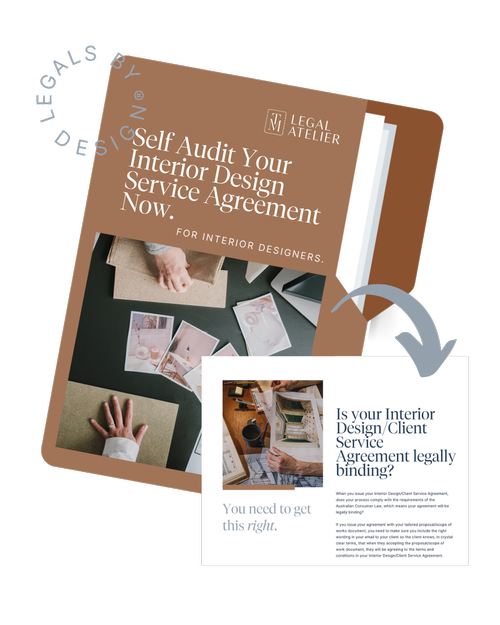
Free download for interior designers
Put your client service agreement to the test with the Interior Design Self Audit Checklist. Know with confidence, once and for all, whether your agreement protects your business the way it should.
Send It My Way