Send a text message to the show
Your website probably works hard for you. It shows people what you do, shares your expertise and, for many businesses, sells courses, programs, products or bookings.
But when was the last time you looked at what is actually happening on it? Not the branding or the colour palette, but the words, the free resources, and what people agree to when they hit "buy now".
Your website is often the first place a potential client checks you out. The right documents protect you legally, and they also tell people you are the real deal.
Watch What Your Copy Promises
Under the Australian Consumer Law, a business cannot make promises or representations it cannot deliver. Most people think of this as a product problem, like a cream that claims to make you look 15 years younger. It applies just as much to services.
"Work with me and you will double your profit" is a promise you cannot guarantee. If that is your track record, say so honestly: "Clients have reported doubling their profit within 12 months." Whether you write your own copy or use a copywriter, check that everything on your site is true and not misleading.
Protect What You Share for Free
Blogs, podcasts and lead magnets are a generous way to deliver value. They also need two things.
A disclaimer. Make it clear your content is general information, not advice tailored to the reader.
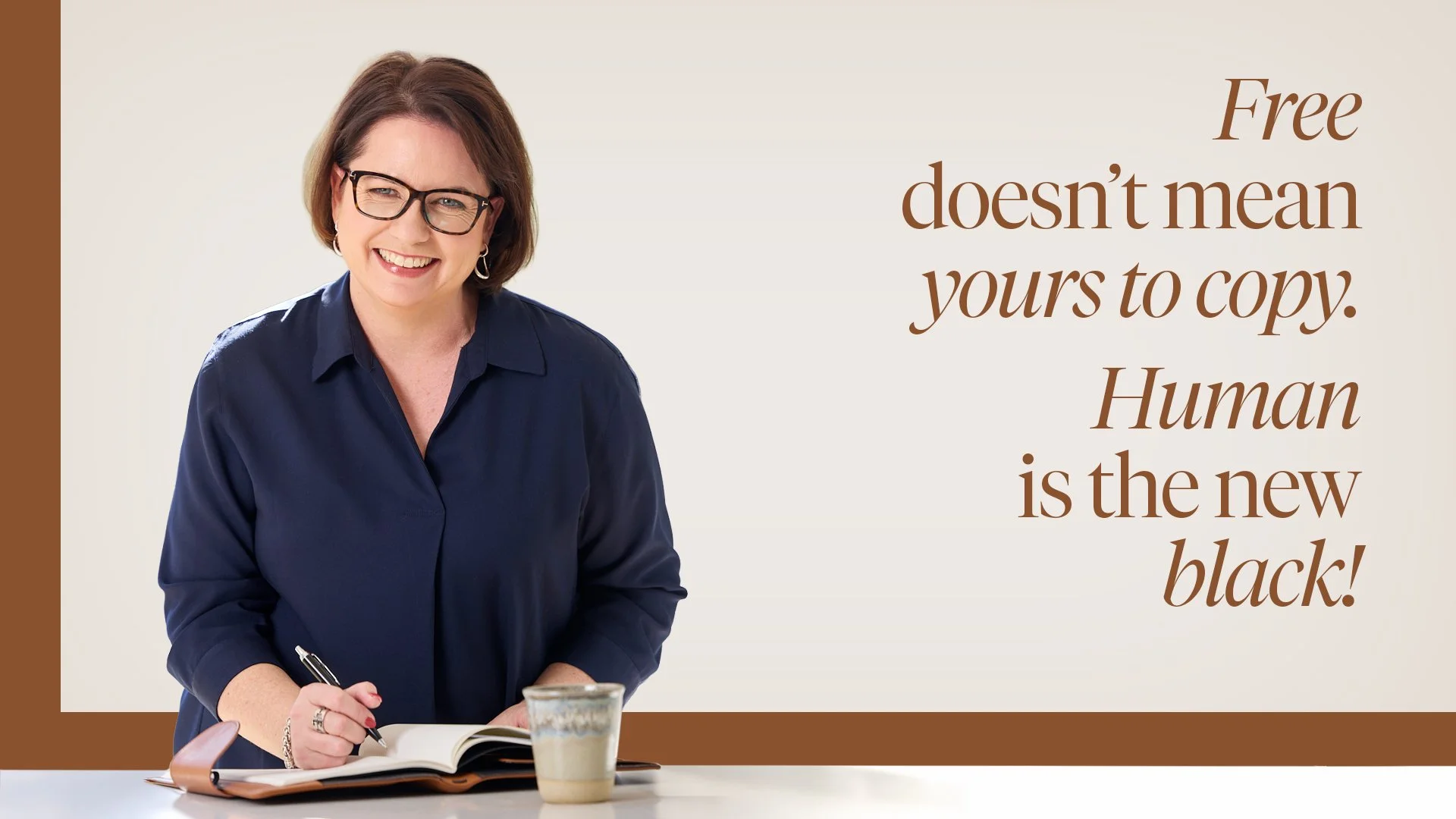
A clear statement that you own your IP. Free to read or download does not mean free to copy, sell or pass off as their own.
Yes, copyright law protects your original work. But most people who cross the line do not mean to. They simply did not know where the line was. Making it clear up front saves you a lot of time, energy and money later.
Website Terms and Conditions
Your website terms and conditions sit at the bottom of your homepage and explain who owns the site, what it is for, and what visitors can and cannot do. This is where your disclaimers and IP protections live, along with references to privacy and the Spam Act, which matters if you are building an email list or sending SMS.
These terms should reflect your business. Copying someone else's or buying a generic template means they are unlikely to do what you need them to do.
Your Privacy Policy
Privacy law in Australia is going through its biggest reform in years. Many small businesses are currently exempt from needing a privacy policy, but that exemption is widely expected to go.
There is also a strong business case. A tailored privacy policy shows visitors you respect their personal information and sets you apart from the fly-by-nighters. Consumers do check, and a missing or copied policy sends a message you do not want to send.
Purchase Terms at Checkout
If you sell anything on your website, from courses and memberships to digital downloads, retreats and events, you need purchase terms that relate to what is being sold. These are not the same as your website terms and conditions.
Sequencing matters. Under the Australian Consumer Law, the buyer must be able to review your terms before they pay. Sending terms after payment means you may not be able to rely on them. A tick box saying "I agree to these terms and conditions" before checkout is best practice, and it must link to the right document, not your privacy policy or website terms.
Using Shopify or a similar platform? The terms that come with it are not designed for the Australian Consumer Law.
What To Do Next
Head to the bottom of your homepage and click your own links. Are your website terms and privacy policy there, and do they reflect your business? Then do a test purchase. Are people agreeing to the right terms, at the right time, before they pay?
With so much AI-generated content around, people want to know they are dealing with a real human who cares. Your website legals are one of the easiest ways to show that.
-
[00:00:50] Tracey: Let's talk about what's happening on your website. I spend a lot of time on this podcast talking about the legal documents that you need in your business to support you and your vision and your [00:01:00] growth, and I spend a lot of time diving deep into the agreements that you have with your clients, your team, structure, all the things.
[00:01:09] In today's episode, I'm going to dive in and spend time talking about the website, what's happening on the website, what legal documents you need and why. First of all, when I say let's have a look at what's happening on the website, I'm not referring to the lovely branding and color palette and layout.
[00:01:27] I'm talking about the offerings. Whether you're selling goods or services or whether you're using your website as a validation tool, as a place where people can come to learn more about you and to learn about the sort of services that you provide, there's a lot of content or copy on those websites.
[00:01:44] And so the very first thing I want to say is we need to be careful with our copy on our website to ensure that we are not putting anything on there that could be considered misleading or deceptive. There's all sorts of rules in relation to [00:02:00] advertising, and there's all sorts of rules, which is my area, that relate to your obligations under the Australian Consumer Law.
[00:02:08] So what a business can't do is make promises or guarantees or representations which it cannot deliver and which are untrue. What probably comes to mind when you hear that is things like products that are being sold, when marketers say things that simply aren't true Or that makes you skeptical.
[00:02:27] Use this product and you're going to lose 15 kilos. use this product and you're going to look 15 years younger. Sure, that certainly is part of it, but coming in through the lens that I am, which is supporting predominantly service-based businesses, we also need to be sure that the copy on our website isn't just as misleading, but in relation to our services.
[00:02:49] So things like, " I'm a business coach, and if you work with me, you'll double your profit or you'll double your revenue." Or, "I'm this type of service provider, and if you work with me, [00:03:00] you're going to sell out your course or sell out your mastermind," or whatever it might be. Those are promises that you can't guarantee.
[00:03:10] You might be very good at what you do, and that might be your track record, in which case, say that. "Clients that work with me have reported that they've sold out their masterminds," or, "have reported that they've doubled their profit in six months or 12 months," or whatever it might be. You see the difference?
[00:03:29] We have to be really careful when we are either drafting our own copy or using a lovely copywriter to draft our copy for us that what's going onto the website is true and correct and not misleading and deceptive. So that's the first thing.
[00:03:43] Second thing is What are you sharing on your website most of the time with a desire to be helpful? So we've talked about the copy, and we've talked about what it is that you do and how you're sharing your expertise with people that are coming to your website to learn about you. But [00:04:00] often business owners will have things like freebie download or blogs or podcasts.
[00:04:06] We'll get into digital products for sale and things like that a little later in the episode. But for now, There's usually some sort of lead magnet, and there's usually some sort of resource.
[00:04:17] As I say, blogs or podcasts, very common. We need to make sure that whatever it is that we are sharing on the website
[00:04:24] Is our original work, one, goes without saying, of course, but I'm not the sort of person to leave that to chance. So one, it needs to be yours, and if it's not yours, you need to state where it's come from. But second, we need to have disclaimers to make sure that when people are coming to our website and they're reading our blog or they're listening to our podcast or they're downloading our freebie, that we're making it clear to them that this is general information and not advice specifically tailored for them.
[00:04:52] You would think, lots of clients have said this to me, surely that's a given. But if you're a longtime listener, you know me, we don't leave these things [00:05:00] up to chance, and we make sure that we're setting ourselves up for success and protecting our business, but also we're managing the expectation of clients and potential clients and consumers using the website so that they're aware.
[00:05:13] Those disclaimers go in the website terms and conditions and, depending on the nature of the lead magnet, sometimes on the lead magnet too. That's the first thing. The second thing, we need to make sure that whatever we're sharing on the website and in those lead magnets, that we have protected our intellectual property.
[00:05:29] So we make it clear that we own our IP, and just because we're putting something on our website or we're putting something available as a lead magnet for you doesn't mean that we are giving away our intellectual property rights. So what we're doing is we're inviting people to come along and read our resources and learn about us and hopefully get real value from the content that we're sharing.
[00:05:52] But you must not copy it. You must not start selling it. You must not plagiarize and pass it off as your own. We like to be really [00:06:00] clear because if we don't say that, there can be assumptions made by users of the website that they're okay to do that. I'm just gonna pause here for a moment and say to you, I'm not talking about legislation here.
[00:06:12] I'm not talking about the Copyright Act and the protections you have. Of course you have all of that. But if you're a longtime listener, you'll know that my approach to all of this and everything that I'm sharing is very holistic, and I look through this through a legal lens and a business lens. So just because we might have a piece of legislation that says if you're the creator of original work, you own the copyright until assigned in writing That's not going to help the user of the website not understand that, "Oh, it was free and it didn't say anything, so I'm gonna go and copy it and I'm gonna start selling it in my programs."
[00:06:45] Those sorts of misunderstandings happen all the time, and so what I do is talk to business owners about how to set them up for success to avoid those situations. It's not like, "Oh, well, we've got the protection of the Copyright Act." Of course you do, but you're not gonna [00:07:00] go and threaten to sue somebody every time that you see your stuff be copied.
[00:07:03] That's not a good use of time, energy, and money. You probably can, but that doesn't necessarily mean you should. I would like to prevent that happening in the first place as much as we possibly can, and that's when I say we're talking about managing expectations and setting the parties up for success. So if people coming along to your website know, because you've made it clear and it's in many places, that whilst they're welcome to download your lead magnet, they're not able to go and reproduce it and pass it off as their own, that's good for them to know. most of the time, in my experience, people don't do the wrong thing because they've got bad intentions or they're trying to be malicious.
[00:07:40] Most of the time they do the wrong thing because they don't know. They didn't realise there was a line, and they didn't realise they crossed it. So what I'm talking about here is, well, let's make the line really clear, and let's make it really clear to people what they can and can't do. So that's the approach behind what I'm saying here.
[00:07:57] Our intellectual property, we wanna protect it, we wanna make it [00:08:00] really clear that just because we're sharing something on our website doesn't mean it's yours to do with what you want. That's the second thing. So where do we put this? Where do we put all this information about our disclaimers, what the website's intent is, what you can and can't do with the content on the website?
[00:08:18] You put it in your website terms and conditions. Your website terms and conditions are the document that you'll find linked at the bottom of a homepage of a website, and if you're not sure, go have a look at mine. Go have a look at my website, bottom of the homepage, and you click on the terms and conditions link.
[00:08:34] And it opens up, and it'll tell you all about the website. This is who owns the website. This is the intent of the website. This is what we're doing on the website. This is what you can't do. This is what the website doesn't do. It's all in there. So that's where you put this information. And then, as I say, depending on the nature of what you're sharing on your website, you might reproduce the disclaimer, for example, on your podcast page or on the bottom of your [00:09:00] resources page or even the disclaimer actually on the back page or the front page of your freebie download or your lead magnet
[00:09:08] That type of approach is nuanced and individual for you, but those website terms and conditions are really important. What we also like to do in the website terms and conditions is make sure that we're referencing the privacy legislation, and I'll get to the privacy policy in a minute. But we also want to comply with the spam legislation.
[00:09:25] So there is such a thing as the Spam Act, which says that if we're going to communicate with people, we need to comply with the Spam Act, and if we're emailing, we need to make sure we've got their consent. If we're going to send SMS, then we need to get their direct consent. So the reference to the Spam Act will be in the website terms and conditions, and that's another big tick for compliance for your business.
[00:09:49] Businesses who are growing an email list or who have a Contact Us page find references to the Spam Act to be really important. So if you're gonna start emailing your list, [00:10:00] we need to make sure we've referenced the spam legislation in the website T&Cs
[00:10:04] From there, the website T's and C's need to be nuanced based on your business, your offerings, and what else you're doing. So for example, my website terms and conditions will be very different to somebody who is an interior designer or a business coach. My website terms and conditions have things in there like if you download my products or my free resources, you don't become my client. you only become my client if I issue you with my engagement terms, so our cost disclosure and costs agreement, for example. It's one of the things that you'll find in my website T's and C's, but that don't suit other businesses
[00:10:43] I will just take the opportunity here to say Because you may think website terms and conditions aren't a document that gets looked at very often, well, if you thought that, you'd be wrong. But anyway, if you think that and you go and copy somebody else's and you just change a few things, chances are they're [00:11:00] not doing what they need to do for you.
[00:11:02] Similarly, if you buy a template, it's not tailored to your business, so it's very generic. It's designed to serve everybody, which means really in practice it serves nobody. It's not tailored to your business, so you can have no peace of mind or confidence that your website terms and conditions are doing what they need to.
[00:11:17] So talk to somebody who does this to make sure that you've got the right documents for your website and to make sure they're comprehensive and tailored for your business. The next document I'm gonna touch on is the privacy policy. This is such a live discussion point at the moment because the privacy policy is undergoing reform and much change for the first time in a very long time, and the change is being rolled out incrementally.
[00:11:41] Typically, most Australian small businesses don't require by law a privacy policy unless you're a business in certain industries. the consensus and the discussion around the changes that are being implemented, however, are all consistent with the expectation that that exemption will be [00:12:00] removed soon, so we don't know anything more in terms of dates and certainty.
[00:12:05] So we've got the legal lens where businesses are starting to say, "Well, gosh, I really think that the exemption's likely to be removed. Let's get our privacy policy in place." So that's the legal lens. The business lens is when businesses are saying, " In this day and age, with so many fly-by-night businesses popping up everywhere, I want to do everything I can to build trust and credibility with my audience, and having a privacy policy is really important to me so that people know I'm the real deal and that I respect their personal information."So I talk about that to my clients all the time. So my clients, just about all of them, have privacy policies. Those that don't, don't have a website. The privacy policy, one, is a legal compliance tool because sometimes depending on your industry and your business and what sort of information you're collecting, sometimes you do legally need it at the moment.
[00:12:56] Other times, though, if you are exempt We're not resting on our [00:13:00] laurels. The business owners are taking the opportunity to use the privacy policy, a compliant privacy policy, which they understand, which is tailored to their business. They're using it as a tool to build trust and credibility with their audience, with consumers that are coming to the website.the privacy policy will live at the bottom of the homepage. The link just next to the website terms and conditions, you'll find the link to the privacy policy on all websites that have them. Again, if you're not sure what that looks like, go along to my website and go take a look When we're building trust and credibility with our audience because we want to do everything that we can to position ourselves as professionals with integrity that clients and consumers can trust, those documents can be very important tools because gone are the days where consumers just don't check.
[00:13:49] They absolutely do, and I have conversations week in and week out with businesses who actually give feedback and say, "My goodness, this is some of the feedback I've gotten off my document. Or, "This [00:14:00] makes me feel really confident. This makes me feel really professional.
[00:14:04] This makes me feel really good about putting myself out there because I know I've done everything I can to build those foundations to ensure that I am standing apart from the fly-by-nighters, and so that people know that I respect their data." It is really important. Now, you may never have looked at these documents, but I suspect after listening to this episode, you probably will.
[00:14:26] I'm the sort of person that when I go to a new website because I'm considering engaging the services of somebody or I'm considering buying a product, I will scroll right to the bottom every single time and look for those website T's and C's and that privacy policy. I know. I know. This is what I do, so I love this stuff.
[00:14:43] But I'll click into them and I'll have a look and I'll see whether or not they've been tailored to the business and whether they're compliant because it tells me so much. It tells me that the business takes this seriously, that they know what they're doing, and it's helping build trust. Those that don't have them [00:15:00] or that have ones that have been copied or are templates and they stand out a mile, they're sending a message of either I don't know about them or I don't care.
[00:15:10] Either scenario is not okay with me, so I'll close that website and I'll keep looking. True story. That's what I do. Take a look at someone's website next time you're there. See what you think. See what impression that leaves for you. So we've talked about the website terms and conditions, their purpose, what it is they're designed to do and why they need to be tailored for you, and we've talked about privacy policy.
[00:15:32] Now I want to get in and actually dive into some detail around the purchase terms and conditions or the subscription terms and conditions or the sign up now terms and conditions that apply to what you're selling on the website. This is different for every business. So if you're selling a course, a mastermind, a subscription or something like that, you need to make sure that you have terms and conditions ready to go for [00:16:00] somebody to tick a box and say, "By ticking this box, I agree to these terms and conditions," before they hit buy now or sign up now or pay now on your website at checkout This is the most important step on any website that sells anything, because this is where your compliance with the Australian Consumer Law comes into play, and this is where you get your protection, and this is where you're managing the expectations of the person buying from you.
[00:16:26] So a course or a subscription or a mastermind, this is where the terms that govern that offering go. So somebody is signing up to your mastermind or your course or your program, they need to have access to the terms before they agree to them. They need to have access to the terms before they lock themselves in.
[00:16:43] The sequencing here is really important because what's not okay and doesn't comply with the consumer law, which means the terms will be worthless, you won't be able to rely on them, is if you have someone sign up and then you send them the terms later. And by sign up, I [00:17:00] mean they sign up, they give their payment details, either full payment or their first payment's taken out of their account, and then they get the terms.
[00:17:07] That's not okay. That's not the sequencing that complies with the Australian Consumer Law. The consumer law requires you to ensure that the person buying from you has an opportunity to review and consider your terms before they decide to engage you.
[00:17:22] That sequencing is crucial. The same applies if you're selling products. Whatever it is that you might be selling, you make sure that those purchase terms are drafted in accordance with the Australian Consumer Law, and they need to be accepted before the person hits buy now. And just a little public service announcement, the terms and conditions that come with a Shopify site or similar aren't compliant with the Australian Consumer Law, just so you know.
[00:17:50] So I've been asked to redraft a lot of Shopify terms and conditions, for example, which I will do, but to make sure that that Australian business is complying with their legal obligations under the [00:18:00] Australian Consumer Law. Now, these purchase terms need to relate to what's being sold. Products, goods, digital products, anything you might have, PDFs for sale.
[00:18:10] You might have masterclasses or something like that that somebody pays and then downloads, or they get an email sent to their inbox, and they can download from the link there. Whatever it might be, those purchase terms need to relate to what it is that they're purchasing The terms need to take that into account.
[00:18:28] So this really isn't a one-size-fits-all. You might be an interior designer and you're selling packs of specifications. You might be selling preliminary drawings or concepts or mood boards, or you might be a different service provider and you're selling PDF downloads. I have Atelier Guides on my website that I've poured my heart and soul into creating because I know the value that they deliver.
[00:18:55] There is a page on my website, The Atelier Guides, where [00:19:00] consumers, beautiful listeners of mine, can go along and have a look and see which one they'd like to buy to assist them in their business. They click on buy, they put it in the cart, then they need to click on there, "By ticking this box, I agree to these terms and conditions," and that sets out the terms that relate to what I'm selling, and they're very different to somebody else's because there's nobody else selling Atelier Guides, for example.
[00:19:23] Same applies to your business. What are you selling? You need to have those terms and conditions there for acceptance before the person purchases. Second public service announcement is these purchase terms and conditions I'm talking about are not the same as the website terms and conditions. So I've had business owners reach out to me in the past and they say, "Yes, I do have all that s- stuff set up at the checkout.
[00:19:46] And I go and take a look, and despite best efforts, there's a crucial piece missing because there is a link there and there is a box, and the box does say something to the effect of, "By ticking this box, I agree to these terms and conditions." [00:20:00] But they've linked to the website terms and conditions which have nothing to do with the purchase, or they've linked to the privacy policy, which again have nothing to do with the purchase.
[00:20:09] So we just need to take care to make sure we've got the right documents and the right terms in the right place and that the sequencing is correct so that people have the opportunity to review them before they lock themselves in. Think retreats, think events. It all falls under the same umbrella.
[00:20:27] Tailored terms and conditions in relation to what's being purchased, set up in the right order. Accepted before payment. That's really important, and everybody does something different on their website. I do something different to what my clients do, to what my colleagues do, to what our lovely accountants do.
[00:20:45] Everybody does something different, but most of the time we all have the same good intention, and that is we want to deliver value, and we want to do that easily and accessibly for consumers and potential clients via our website So once upon a time when we [00:21:00] thought it would be really easy just to set up a website and put a few things on there and see how it goes, we really need to step back now and take stock of what's happening on the website to ensure that, one, we're legally compliant, because that's so important.
[00:21:13] But two, we're setting ourselves up for success with our clients, and we're using our website and what's available on our website to build trust and credibility, because that is so important, particularly given the climate we're in, which doesn't look like it's going to change anytime soon. Because there is so much AI around, I genuinely think that human is the new black.
[00:21:35] I really do. I really think that human is what people want. There is no end to information and material that people can get these days, and they can ask ChatGPT a whole series of questions. You can have absolutely no confidence, however, that with most industries, and law certainly one of them, that what ChatGPT tells you is accurate.
[00:21:55] But what we want to be doing as service providers is make sure that we're setting [00:22:00] ourselves apart from all of that, and that people that come to our websites know that they're dealing with a real human who actually cares. And that's why I spend time talking to clients about website terms and conditions and privacy policies, because they're so important, not just through the legal lens, but through the business lens to build trust and credibility with your audience.Go the step further, though. Don't stop there, because if there is something on your website where people are paying, bookings, all the things we've talked about, make sure you've got the right terms and conditions for that offering in the right place, that people are clicking at the right time and before they're purchasing.
[00:22:40] So they're your clickwrap terms and conditions. Just quickly, if you're wondering why they're called clickwrap, I'll tell you. The clickwrap terms and conditions are called that because you click a box, so they're wrapping around once you click that box, and that's when they become binding. That's the clickwrap version.
[00:22:59] The alternative [00:23:00] is browsewrap. Browsewrap is when you don't click anything, but there's something that says, "By continuing with your purchase, you're agreeing to these terms and conditions," and there's no affirmative step or no positive step that needs to be taken to agree to them. That's the browsewrap Best advice, best practice is we don't want that because the Federal Court has held over many years that as a consumer, if you take the step of ticking the box to say, "I agree to these," even if you don't read them, it's too bad, so sad because you ticked a box to say that you did.
[00:23:35] So the business owner is protected. So you can't come back later and say to the business owner, "Oh, but I didn't read them, therefore, I don't agree to be bound by them." That gives the business protection by having that need to tick the box, hence clickwrap. The browsewrap doesn't have the same protections the court's held, so we can have no confidence.
[00:23:54] The court can have no confidence that by proceeding with that purchase, one, the consumer read the [00:24:00] terms or had access to the terms because the link may have been broken, for example. That doesn't apply with the clickwrap because by ticking the box, they're actually saying, "I've read them," which means they were able to access them to read them.
[00:24:11] The browsewrap, not so. So that's the difference. If you want to dive into any of this in more detail, you are so welcome to go to the resources page on my website. I'm spending a lot of time at the moment refreshing all of the articles and blogs that are on there to make sure that they're current and that they're valuable for the climate that we're operating in today.
[00:24:32] So you can go over to the website, tmlegalatelier.com.au. Go to the Resources page, and there is a ton of articles that I've written personally on that page designed to help you. You can search by topic. We've got categories and website documents and privacy policy have their own category because it's so important, and I've written about that.
[00:24:53] And you can take a look at anything else that's there that's gonna be of value to you. If you have business friends that are operating in this [00:25:00] space that you think would benefit from that, Please share those resources widely and freely, or let people know, "This is a business lawyer.
[00:25:06] She's written about this. You can check it out on her website." I hope you have found that to be valuable, and I hope you now understand why I'm so passionate about the website documentation because websites are such an important and valuable tool. We need to set them up for success and do everything we possibly can.
[00:25:22] Thank you so much for joining me. I'll catch you next time.
[00:25:24]
Join Me on Social:
Rate, Review and Follow me on Apple Podcasts
If you loved this episode, please consider rating and reviewing my show! This supports me in helping to empower more coaches, creatives and consultants - just like you - protect what they're building, and move forward with confidence in their business. It's quick and easy - click here, scroll down to the bottom, tap to rate with 5 stars and select 'write a review'. As always, I'd love to know what you think, and what you loved most about this episode. Also, don't forget to follow the podcast to stay up to date with the latest episodes.