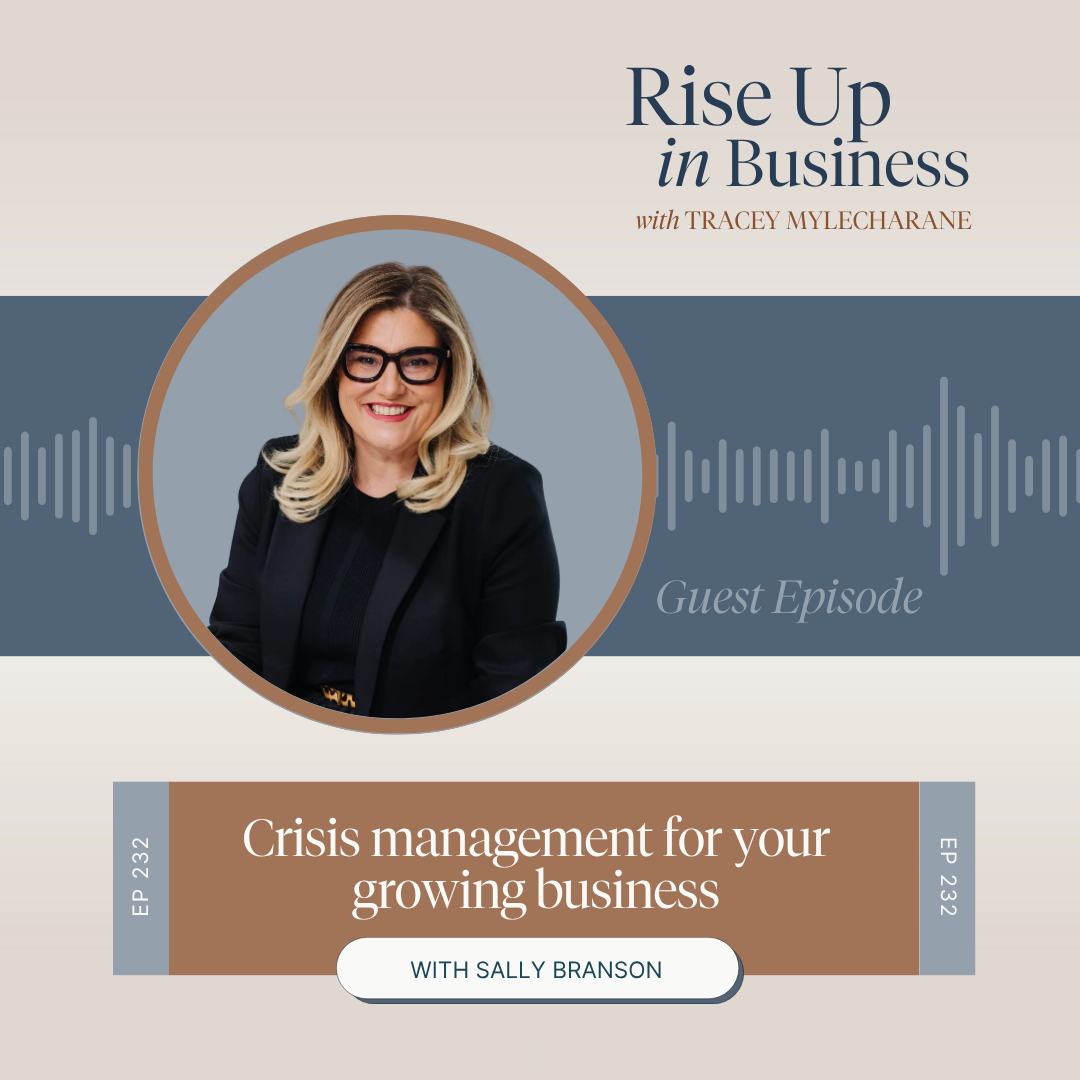
#232 - Crisis management for your growing business, with Sally Branson
Send a text message to the show
The 2:00 a.m. spiral is trying to tell you something
Have you ever found yourself awake at 2:00 a.m., running through every possible “what if” in your head about your business? Let me tell you, you are not the only one. That late night spiral is usually your brain trying to protect what you have built. Which is exactly why crisis management for small business is not something you leave until you are already in the middle of a mess.
Why crisis management matters for small and medium businesses
I recently spoke with crisis management expert Sally Branson on the podcast, and the message was clear. Crisis planning is not about being dramatic or expecting the worst. It is about being prepared. The same way you would not go on a hike without water and a map, you should not be growing a business without a basic crisis management plan. Because when something goes wrong, you do not rise to the occasion. You fall back to whatever systems you already have.
The myth that keeps business owners exposed
One of the biggest myths Sally called out is the idea that small and medium businesses do not need crisis management. If your business is your livelihood, a hit is a hit. It does not matter if the crisis costs you $800 or $80,000. It still hurts. And the point of crisis management planning is not to predict every possible disaster. It is to have a clear plan for how you will respond, who does what, and what steps you take first when the pressure is on.
Crisis hygiene is the boring stuff that saves you
A big part of this is what Sally calls crisis hygiene. These are the everyday habits that reduce risk and protect your business reputation before anything even happens. Think practical stuff like two factor authentication, secure passwords, access control, and keeping your systems tidy. It is not glamorous, but it is business risk management at its most useful. It is the difference between a problem being annoying and a problem becoming a full scale business crisis.
Your reputation buffer is built before the crisis hits
Then there is the reputation buffer. This is the trust you build with customers, clients, partners, and your wider community. When you have a strong reputation, people are more likely to give you the benefit of the doubt when something goes wrong. They are more patient. More supportive. More willing to stick around while you fix it. Reputation management is not something you do after a crisis. It is something you build quietly, consistently, over time.
There is always a solution, but you need a plan to find it
One of the most grounding lines from the conversation was simple: there is always a solution. It might not be the outcome you wanted. It might not be neat. But there is always a way forward. That mindset matters in crisis response, because panic makes everything worse. Preparation gives you options.
Values are not a vibe, they are a decision making tool
Values matter too. When a crisis hits, your values stop being words on a website and start becoming decisions. How you communicate. How you take responsibility. How you treat people. How you make calls under pressure. Businesses that respond in a way that matches their values tend to recover faster, because people can feel the integrity in it.
Build your wisdom council before you need it
And finally, Sally spoke about building a “wisdom council”. Not just a professional network, but a real support system. People you can call when you are stressed, stuck, or too close to the situation to think clearly. Mentors, peers, advisors, maybe even a competitor you respect. Crisis management support is not only about plans and policies. It is also about having humans around you who can help you stay steady.
Crisis management is part of sustainable business growth
Crisis management for growing businesses is not a nice to have. It is part of building something that lasts. So if you have been putting off crisis planning because it feels like something for bigger companies, take this as your sign. Start small. Get your basics in place. Build your buffer. Tighten your risk management. Because when the crisis comes, you will be glad you did.
-
Speaker: [00:00:00] Hi everyone. Welcome back to the podcast. If I was to ask you [00:01:00] what is your crisis management plan for your growing business, what would you say? if you're like many of my clients, you would probably either look at me blankly and say, "I don't know," or you'd ask the question, "What do you mean by crisis management?"
Some business owners say to me, "My business isn't a big corporation, so I don't need crisis management planning." I want to dive in and talk about that in far more detail in today's episode, and it's perfectly fitting that I'm joined by a very special guest. In today's episode, I'm joined by Sally Branson, who is a boutique crisis management consultant and a very dear friend of mine.
So it's very fitting to have Sal on the podcast today, and I think you're going to love this conversation because there are so many synergies in the way Sal and I think, in the way we support our clients, and in the way we approach the prevention being better than element in business. Sally shares so many nuggets of gold that every business owner will be able to pick up and run with from today's episode.
She's very [00:02:00] generous in the information she shares, and she shares with us too
A resource that she has available on her website, which I think is incredibly helpful for business owners. let's get into the episode. I hope you love it as much as I did.
Tracey: Hello, Sal. Welcome to the podcast
Sally: Oh, Tracey, thank you so much for having me. I feel like we've spoken about this for so long now, and we're finally getting it done.
Tracey: We have, and I can't wait to share this with our listeners because I know that there's going to be so many nuggets of gold in this conversation that business owners can just take away, and I'm so here for that. So thank you for joining me.
I have been so keen to get you on the podcast to talk about crisis management for businesses.
Small businesses and medium businesses I often hear say, " I don't need to think about crisis management," in the same way they say, " I don't need to think about legal contracts. Don't need that." And I spend so much time demystifying that myth and explaining to people, "Actually, you do need it, and this is why."
Let's focus on crisis management. Just in a nutshell, for those [00:03:00] who don't really think it applies to them, What is it, and why do you do it? Let's just start the conversation there.
Sally: Well, I think, Tracey, that's why you and I, became firm friends so quickly because we have the same viewpoint around the values and benefit of having great legals being pr- because legals really are crisis documents. They're to prevent a crisis or an issue from happening, and they're to protect you if you've got a crisis or an issue.
So for me, you and I share the really similar pathway to making sure that businesses and brands, SMEs particularly, know that we're myth-busting and that we're giving them the best advice around how to be best prepared. So I always say-- people often say to me, "What's the difference between a crisis and an issue?"
And I say, "An issue sort of bubbles along," and we can go into the genesis of crisis and crisis theory. But an issue sort of bubbles along, but it escalates to a crisis when it impacts your daily ability to do your work and earn your income. [00:04:00] So when it starts to have multiplying effects or when it starts to have immediate, you know, barriers or stops to you doing what you love to do or running your business, whether it's because you physically can't, because you emotionally can't, because it's costing you too much money, because you know you've got a social media campaign against you.
These are all things that don't come overnight, and won't ruin your business or brand overnight because the hill that I will die on is much like legals, crisis planning should be business as usual planning. You should have your legals plan, and you should have your crisis planning plan just like you would have a financial forecast, a marketing plan, a social media plan, a supply chain plan.
All of those fit under a banner of so- of crisis management as well. But it's business as usual work to best protect you from all of the worst case scenarios.
Tracey: Oh, thank you. That is so helpful. I [00:05:00] say over and over and over again, there is no substitute for preparation. That applies to everything you've just rattled off. Everything you've just listed is everything where I say there is no substitute for preparation, and we need to get our head around this as business owners because the buck stops with us.
We're responsible. We're the business owner, and now that we're the business owner, particularly growing businesses, we can't stick our head in the sand and say, "That doesn't apply to me. That won't happen. I'll think about that later." So business as usual crisis planning. Talk to me about that
Sally: Let me step back for something that you've just mentioned there, Tracey. One thing I hear all the time in that same, you know, "I don't need to plan or I can't," the two biggest myths for me is, "I'm too small for a crisis." But that's not true because it's all relative. Like we look at what happens to big brands like Woolworths and Coles and Optus and IOA.
So they learn from comparison. in their handling of a crisis went well and didn't go so well? And how can you learn as an SME? So the reality is, it is all relative. So [00:06:00] we're might not be talking about a crisis that affects you to the tune of eight billion dollars, but if you're an SME and you've got a crisis that affects you to the tune of eight hundred or eight thousand or eighty thousand, that's a big crisis in your business.
So that's the first myth around that, "I can't plan because, you know, I'm too small. A crisis isn't gonna happen to me," and, "What's the worst that can happen?" I think as, as small and medium business owners, we don't wanna think about the worst case scenario because it's too scary, because you said the buck stops with you.
The buck stops with me. It feels insurmountable. And the other myth that I hear all the time, and I think is one of the most damaging things for a small to medium enterprise or a brand or an individual, is that, we can't plan for a crisis. It's just gonna come-- Something's gonna come overnight and it's gonna ruin our business overnight.
there's no way we can plan because we don't know what it is or if it's a crisis, we can't do anything about it anyway. Now, that is the biggest myth [00:07:00] 'cause every single crisis can be planned and prepared for. What I say is that you may not know the content of the crisis, but you can know your business.
By knowing your business, you know the context of a crisis. So may it be a supply chain issue, may it be a negative Google review that's like a slow burn crisis or a creeping crisis when there's two or three or four or five negative Google reviews, you know that there's an issue and there's something in the back end that's causing it, so go back and fix that to stop it becoming a crisis.
But equally, if you're a service-based business, it's very easy to understand what crisis may affect your business and how then to plan for it. You might not know all of the content, but you can put a context around it by saying, "Have I got legally safe talking points? Do I have someone on board I can ring?
Have I got good legal advice? If my Instagram was closed down and I'm an e-commerce online business that rely on Instagram, do I know the steps to [00:08:00] recover that? Have I got it saved in a document?" All of these things that we can do before a crisis hits. And in 2026 there's no excuse not to be prepared.
Our customers, our clients, they expect Good crisis behavior, good crisis hygiene, so digital, cyber. But equally, because we've been in an environment of crisis for so long, so we've had COVID, Now we've had fuel and fertilizer costs, we expect businesses to have a playbook or a game plan if a crisis hits.
And if they don't, it lessens their reputation buffer. And if we can talk later on, Tracey, about what a reputation buffer is, we can all be doing that every day to help protect us from a crisis
Tracey: That is all gold, Sal, and I've just made some notes. Can we go back to crisis hygiene? Can you unpack that a bit more, please?
Sally: Yeah. So crisis hygiene, look, hope that's just a term I've made up there, Tracey.
So crisis hygiene are things like having two-factor authentication, knowing where [00:09:00] your passwords are, having password protections, understanding what a cyber breach might look like in your business because cyber breaches are so common.
And the other thing, there are so many great free resources about cyber breach. I think for an SME audience, there's a great group called Cyber Wardens, and three times a month they run free training on better cyber hygiene. So it's about looking at your business, and in 2026 use AI. I'm a big believer in AI not the top level, but the really base level crisis planning.
So put in a prompt to AI and say, "Hi Claude. My name is Bob. I own a business that sells nuts and bolts. It's 2026. My business is based in a regional city. I employ five people. what are the issues that could affect my business today?" And AI is so good that it will spit out a list of maybe 10 or give me the top 10 in your prompt.
Be really explicit. " Give [00:10:00] me the top 10 crises that could affect my business today." and you get that base work done for you. So the hard starting point is lessened, and I find that a lot, Tracey, that people don't know where to start with crisis because it feels so scary and big, and I think people probably feel the same way about legals to a
degree.
Tracey: They do. They do.
You've just given us an amazing AI prompt. I'm a fan of AI. I think AI has its place, absolutely. It's powerful when used well. It has its place. I say it on here a lot. Its place is not for drafting legal contracts, and we'll save that for another time.
But it is, though, for creative thinking, brainstorming, developing a platform. But I always say the output is only as good as the input, and you've just given an excellent AI prompt to go through that. So everybody listening can go to AI right now and put in that prompt to something to start thinking about when we think about crisis.
Because I suspect the majority of people listening are thinking, well, before they tuned in to listen, would've been thinking, " I don't need crisis management. My business is too [00:11:00] small. It doesn't apply to me."
Sally: Exactly.
Tracey: it does apply
Sally: I see this often, people say, "Oh, I'm not big enough" or... But actually a crisis and a reputation crisis, let's just give an example. What if you're a small, in a small country town and you own, uh, the local fish and chip shop and, one of your staff members is accused of, sexual assault or sexual harassment against another staff member?
The implications of not handling that well enough can be really business-ending and detrimental. And that's that hygiene point, that if you don't have a pathway or if you don't recognise what you would do in that situation, and you don't have, you know, your ideal talking points, you don't know what your values are, so you can't speak to your values in a crisis.
So I often say, you know, I had someone come to me and say, you know, "Our values are-- and it's all over our annual report and it's everywhere, is we're really authentic." and they had a crisis and I was like, "Okay, we're authentic and we, you know, we're great communicators." And they're like, "Oh, we don't wanna tell anyone about this crisis.
We don't want [00:12:00] anyone to ever know. We don't want it to see the light of day." But media were already involved, so it was gonna see the light of day. So if you really are authentic and you really pride yourself on good communication with your stakeholders, you don't put your head under the sand. So it's about knowing your values, knowing how you'd speak to your audience.
Tracey: That's so powerful right there, and I suspect there are people listening going, "Gosh, I think I need to revisit my values," because they evolve over time and develop as we grow as business owners too. And sometimes we just assume that everybody knows our values, but we haven't revisited them for such a long time, and we realise our messaging has become misaligned or there's a bit of a mismatch between what we say our values are and therefore how are we supposed to actually deal with something.
So I think that that's really, really wise what you've said there in terms of being able to talk to your values and, and think about that. So that's a really grounding place to start, as well as the AI prompt to give you more food for thought and to give you a starting point of what you should be thinking about here, which really valuable.
What about reputation buffer? What [00:13:00] is that?
Sally: That is all the work that we do, and if we're good operators and we're managing good businesses, and we're looking after our clients and our stakeholders, that's about building a reputation buffer. I know, You know, 10 years ago, there was a lot of talk about, you know, um, the emotional intelligent and building a bank of goodwill.
It's that sort of conversation. So what do you do on a daily basis so your stakeholders, your client bases, your customers know that you're an honest broker, know that you're trusted, know that you will say that you, you will do what you say you do? They're all pieces of the reputation piece. and there's so many quotes.
It goes back to the Stoics, that the Stoics that you can't put a price on reputation because it is your most valuable asset. But you can build it, and you can build it and grow it and nurture it. you think, "Who's important to me? Who do I need to be talking to in my stakeholder list? who pays my bills?"
I often say people like, "Oh, we don't know where to start working on our stakeholder list if we were to have a reputation crisis." And I'm like, "Well, first st-think about whose opinion really matters to you. Like, who [00:14:00] do you love? And is your partner gonna speak to you the next day?" All of those sorts of things.
"Will your children be proud of you?" Those sort of questions. But actually, let's be really mercenary and say, "Who pays the bills? Where does the money come from? Am I looking after those people? and what can I do to make their experience with me a good one?" And that's that reputation buffer. So if something goes wrong, and most of the things that I see, so I see that people have made a poor decision and they're willing to repair or, I see a lot of case people have made a poor decision about someone they've employed or someone they've been in a relationship with.
Then you think, "Who do I need to have a good conversation about this or with? How do I communicate with them?" The other thing I see, you know, when it comes down to planning is people saying, "I'm gonna send an email out, and I'm gonna explain what's going on." And, and I say, "Yeah, but you've only got a 12% open rate, but you've got such a good engagement on Instagram.
So are you talking to the right people at the right place?" Like it's just about knowing your audience, knowing how they get your messaging, and then, you know, speaking to them [00:15:00] in the language they've come to expect from you.
Tracey: I have a burning question, Sal, and I suspect this is gonna land really well for the listeners. if an SME doesn't have crisis management plan, they've never thought about it and never done anything in relation to crisis hygiene, reputation buffers, none of that, and they land in a crisis, why is that harder to deal with than somebody who has been planning and doing all the things?
Can you tell me the difference just so that this can resonate on a really practical level?
Sally: Let's be really visual about it and think, if you were about to head off on a bushwalk, would you go without water? Would you go without a map? Would you go without a GPS or a compass or a phone? The question is, if you did that, your likelihood of getting lost, getting injured, getting all of it, getting dehydrated is so much higher.
It's the exact same thing. You need the tools and the pathway to navigate. Now, I have seen CEOs of stock [00:16:00] exchange listed companies, I have seen very high profile individuals managing organizations with very big budgets, and they've got stuck in a crisis, and they've got no step forward. And I think too that, you know, if you're in a crisis, there is a great deal of emotion and stress and, you know, there's some trauma response from what's happened in the past or what hasn't happened.
We bring a lot of ourselves into crisis, and if you have a really clear pathway, your decision-making is clearer. Emotion isn't getting in the way. It- it's okay to be emotional, but it's not shifting or changing where you would go. and it's a very clear process. And also, if you've got more than you in your team, there are other people you can delegate roles to in a crisis, and having that all done beforehand makes crisis more as a business of u- as usual event than it normally would be.
So I've got a very large client, they're an international client, [00:17:00] and when they came to me a year ago, they had crisis every week, and their team was running on empty really, they felt very traumatized and very exhausted by all the crisis. They're in a very issues-rich field. And we just went in and did all the planning.
So now it's not that they're not having the crisis, it's just that the magnitude of effort, skill, time, emotional energy has come right down to the crisis being treated as issues, because they are business as usual issues in this line of work. And so it's taken the pressure off the team, it's taken the pressure off the leadership.
They've got really clear pathways of what they can do, what they can say, who's in charge of each instance. And that works the same in a big organization as it does in a small organization. I see often small businesses or, or sole traders or individuals say, "You know, it's just me.
I don't know what to do. How would I get support?" My best piece of [00:18:00] advice to them is set up your own little council of, elders or council of wisdom or privy council. have a competitor in your space who is not competitive. So I know in myself, somebody I run ideas through all the time is another person who deals in crisis communication, and she's a direct competitor, but we care deeply about each other, and so we always check in with each other.
have some sounding boards. Find someone who loves you and, and is gonna tell you you're doing an amazing job no matter what you're doing to keep the ego and the energy high. And then find someone who's a natural pessimist who will say, "This is how badly things can go downhill if you don't get on this train now."
So, you know, create your own little advice and guidance council. And we've actually got a product, um, just it's a crisis starter kit, and it's a really easy entry into thinking about this. It's like a four-page. It works with AI, and it's a really easy entry point where you can start to plan for any sort of crisis, recognise the crisis that [00:19:00] you've got, and just have some good steps forward.
Because if we haven't got the steps forward, we feel so anxious about the crisis, we're laying awake at 2:00 a.m. in the morning when actually let's just get it down on paper, save it in a folder, and look at it every month. But don't come back to it unless you need it
Tracey: So much to say with all of that. That was just excellent. What resonated so deeply when you just said about creating your own council is I talk so often on here about the importance of who you surround yourself with in business, and this is just another tangent of that. It's so important, and I love that you've shared that and given some examples because that's so incredibly helpful, and I'm hoping that people are ticking through their mind now going, "Oh, yes.
Well, actually, I have started crisis management because I do have some risk mitigation and I am across cyber and I do have some people. It's just not formalized yet." So the point is, let's formalize it and treat it with the respect that it deserves. But can you talk a little more about the starter pack?
Because I think that's really attractive and it's gonna be really helpful
Sally: and I'm not, obviously not here to sell my starter pack, but I was just [00:20:00] thinking that the reason I, I made it actually, I actually sat up till midnight one night. It was when in the first week when there was that real discussion about are fuel and fertilizer prices going to impact supply change, and particularly small to medium enterprise.
There's a lot of talk about, you know, the big providers here, but there was less so on what if you're a small to medium en- enterprise, your, your fuel prices were about to go. And it really came from the fact that my brother, has a farm-based business, and what would normally cost him $300 in diesel to undertake for a client was costing him $1,000.
So he said, "Well, how do I up my prices and how do I communicate that?" So that's where-- That was the genesis that I was like, "Well, what's a really good tool?" And in the tool it goes through and it uses... It has AI prompts. You don't have to use AI, but it does have AI prompts just to simplify it and make it faster.
That goes through what are your values as a business? Who are your key stakeholders? What's your stakeholder mapping? What are your key messages? How do you think this might affect your business? If this happened, what would X [00:21:00] happen? So it really is a very practical tool that you come out with a very good, robust, but very basic crisis communications plan, and crisis plan and stakeholder mapping.
And it's a really good start because it takes the drama and intrigue and mystery out of crisis planning. So it's been quite popular just because it is that good start. And also for some people, you know, I've had a broad range of people come back to me and they've all said, you know, it's created a little bit of a thinking document, but equally in some instances it's good to know that they're on the right track
Tracey: I love that. That's so helpful, Sal, and thank you for sharing that, and thank you for sharing the genesis of where that came from because that was really good context to understand. We're so aligned in our messaging for business owners. Prevention is better than cure. There is no substitute for preparation.
Let's break it down. Let's simplify it. Let's support you. Let's develop it. If somebody does, though, have developed their crisis management plan and they've got, [00:22:00] they've got a little bit of a framework and they've got the nuts and bolts together, and so they're doing the work to get started, when is it that a, an SME reaches out to you?
So they've got the work, they've done that, but guess what? They've now landed in a crisis and we've had that moment of, panic and it is highly emotive. Is that the point someone reaches out to you to say, "My goodness, I need help with this"? What does that look like? Can you just share that with us for context?
Sally: such a good question. I actually include it in the starter pack because-- and I've written, you know, if, A doesn't go to B, it's time to get professional advice. I think there are so many factors that, sometimes you need someone who just does it all the time. So we don't do any others. We're not selling toothpaste, we're not doing any PR, we're not placing op-eds, we're not doing it.
We're only doing reputation and crisis. It's all we do and it's all we think about. And I think for many people, it just saves them that step. Let's get someone who's professional on board. Let's get it done. I've got a client at [00:23:00] the moment who has got that horror of all horror calls that "A Current Affair" are doing a story on them.
And they were like, "You know what? We can muddle the way through this, but actually I'm very scared. I'm being trolled online, all of these things. I need professional help, and I will pay you to get professional help." I think it, when it, becomes something that is really, tipping over from, "I can't handle this myself," and that anxiety that if I do try and handle it and make a misstep, I will misstep further.
And unfortunately, a lot of people do come because they've made a poor judgment or they've made a poor decision, and th- it's something that they feel particularly, I think for female SME owners, they feel a lot of shame around. And so having someone to guide them through that process, I think is really important.
And, and I've seen that. Do you know what? I had, maybe three months ago, I had two weeks and it was all male CEOs of, companies who were making a lot of money and each week, we had really teary conversations, very [00:24:00] emotive conversations, very emotional conversations. And having someone who's impartial to give you comfort and guidance through that, I think, I think that's where um, my little firm, we're just a little firm, but you know, we stand out from other people because we're very much around making sure our clients are really well looked after in every area of their life when they're in crisis.
So people are often surprised that one of the first referrals I do, I ask them two things: Have they got good legal advice, and have they got good mental support scaffolding around them? And if they haven't got either, that's when we recommend that they're the first steps that they take before they do anything else.
Tracey: there's many points of difference that you have and I've, I'm very aware of many of them, but it's that holistic approach I think is first and foremost absolutely the one because like most small businesses, it's soul-led, it's heart-led, it's coming from a place of genuine care and I know that your clients are not numbers.
They never have been, they never will be and that that's a, a [00:25:00] massive point of difference. So it's lovely to hear that it's the holistic support. So it's the very much jump on the prevention's better than cure train 'cause we're on it and I'll never get off that, so there's that. But then there's also the if it gets to the point where it is impacting you, you can't run your business, it's impacting you in terms of stress and emotions, then you can also jump on late, better late than never, but you can still jump on then.
That's super important. This has been so helpful and there has been so much value here, Sal, and so much food for thought. I, for one, love following you on LinkedIn because you share so much on LinkedIn in terms of real-life examples of what's going on now and I love the commentary that you're so generous with in terms of this has been done really badly.
This would've been good if this had've happened because we learn from that and I learn from that and so I would love for business owners listening to this to go along and follow you on LinkedIn too because there is so much you can learn from Sal just on the day-to-day in terms of the context that she shares and the commentary that she provides.
We're going to put all the links in the show notes to your website, [00:26:00] to your LinkedIn, and to the starter kit. Thank you so much for sharing that. It has been an absolute pleasure having you on the podcast, Sal. Thank you so much for your time
Sally: I'm so pleased we finally got to chat, and if I can just give one word of advice, and it's funny you say about LinkedIn because Kate who works for me is always like, "Stop giving all the secrets away on LinkedIn. They sh- people should be paying for those." But I think that the greatest piece of advice that I can learn, instead of being frightened or worried or anxious about crisis planning, let's learn from comparison.
Let's look at who's doing it well and learn from them. Let's just know that there's always a step forward. And the other favorite thing that I like to say so much, in fact, that my boys say it all the time, and they're just little, Tracey, you know, they're nine and seven, and they're-- anytime there's something that hits that anxious button for them, they say, " There's always a solution." And it is, there's always a solution. It may not look or feel what your ideal outcome might be, but it's a solution and it moves you forward
Tracey: Let's just end [00:27:00] it there. That's just gold right there, Sal. Thank you so much
Sally: Thank you for having me
Speaker: Oh, there you have it, everyone, my conversation with Sally Branson. I really hope you took nuggets of gold from that. I know I did, and there are many clients of mine who have spoken to me about crisis management recently because it is topical, it is important, and when businesses are growing, planning for that growth is crucial.
We will include all of Sal's links that we've mentioned in the episode below in the show notes. And if you loved the episode, I'd be so grateful if you'd leave a review wherever it is that you listen to your podcasts, Because that's how we help get the podcast into the ears of even more business owners. As always, thanks for joining me. I'll catch you next time
[00:28:00]
LINKS:
Sign up for my fortnightly Atelier Briefings here
Check Your Legals with the Essential Legal Checklist here
Book a Complimentary Introduction Call with me here
Sally's website https://www.sallybransonconsulting.com/
LinkedIn page https://www.linkedin.com/in/sallybransoncrisisprreputation/
Free guide: sbcg.au (Calm in a Crisis) https://www.sallybransonconsulting.com/store
Crisis and Issues Starter Kit: sbcg.au/crisis-kit
https://www.sallybransonconsulting.com/store/p/crisis-and-issues-starter-kit
Join Me on Social:
Rate, Review and Follow me on Apple Podcasts
If you are loved this episode, please consider rating and reviewing my show! This supports me in helping to empower more coaches, creatives and consultants - just like you - protect what they're building, and move forward with confidence in their business. It's quick and easy - click here, scroll down to the bottom, tap to rate with 5 stars and select 'write a review'. As always, I'd love to know what you think, and what you loved most about this episode. Also, don't forget to follow the podcast to stay up to date with the latest episodes.